
Leading the way: Innovations in public good data research
This year has seen ADR UK take the lead in driving forward the public good use of administrative data for research. From unlocking new research possibilities through our flagship datasets and provision of synthetic data to building new collaborative partnerships, the programme has taken bold steps this year. Here are some of the ways we’ve taken a leading role:
Pioneering synthetic data and secure data access
Much of our work across the partnership is dedicated to ‘smoothing the researcher journey’. The emerging practice of producing synthetic data is increasingly playing an important role in this as a valuable tool for research planning, collaboration, and training.
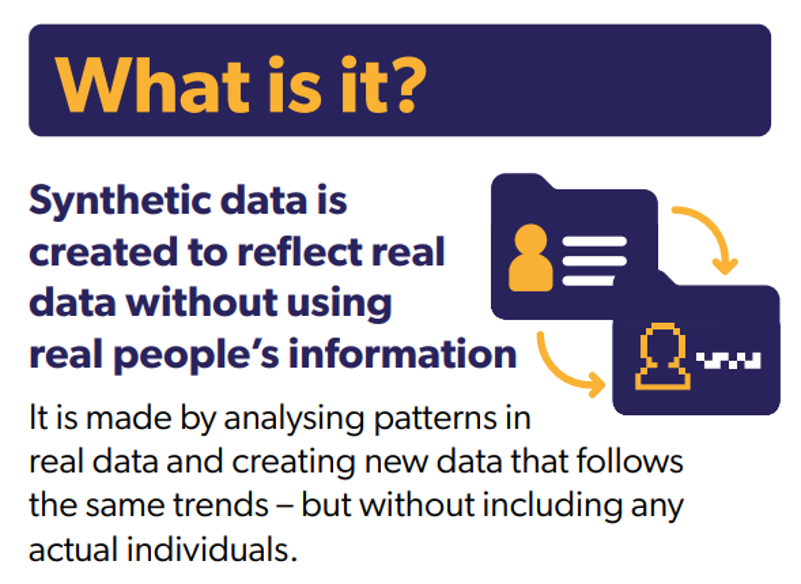
This year, two funded projects explored perspectives of the public and of data providers on synthetic data. A cross-sector working group considered the researcher perspective, and ADR UK has worked to clarify terminology and understand use cases. Future priorities include building consensus on principles and policies for routine synthetic data production.
Progress in this area led by ADR Scotland has seen new synthetic datasets from National Records of Scotland, now available through Research Data Scotland’s synthetic data access process. These low-fidelity synthetic datasets - based on Scotland’s 2001 and 2011 censuses - have been created using the metadata of the original datasets. While they cannot be used for analysis, they allow researchers to assess whether the real data will suit their project, and begin developing code while awaiting access to the real datasets.
NISRA has established governance documentation and regular meetings with ONS to enable smoother transfer of data, opening up remote access opportunities to their themed and flagship datasets where possible.
The Welsh Government has increased transparency around access arrangement for Welsh Government microdata by publishing guidance for researchers on access to Welsh Government microdata. The guidance highlights access routes to Welsh Government data linked to other datasets in SAIL, as well as access to unlinked Welsh Government data in the Welsh Government’s Secure eResearch Platform (SeRP) platform. The guidance also includes information on the Welsh Government’s project approval process, to help researchers understand how decisions are made and what kind of feedback they may expect.
Secure data access is another key aspect of smoothing the researcher journey. Remote access via assured organisational connectivity agreements continues to be a popular offering in the ONS Secure Research Service. Currently, 285 organisations are accredited for this service – more than double the number from two years ago. Each organisation can now provide researchers with 24/7 secure access to the Secure Research Service from a much wider range of locations.
Advancing data use: Linking data, identifiers, ethics
Across the ADR UK partnership, newly available datasets have opened up opportunities for analysis and policy-relevant insights.
For ADR NI, the Northern Ireland Statistics and Research Agency (NISRA) launched the Census 2021 Comprehensive Microdata in October 2024, marking the first time Northern Ireland’s Census 2021 data has been made available at this level of detail for research.
Similarly, ADR Scotland partners are working to improve census data access and research opportunities. The new Economic and Social Research Council (ESRC)-funded Cens-able project aims to increase researcher knowledge of best practice in linking, accessing and analysing census-linked datasets in Scotland’s National Safe Haven focusing on:
-
the 2022 Scottish Census
-
the Equalities Protected Characteristics dataset (currently at proof-of-concept stage)
-
the Annual Survey of Hours and Earnings.
A recent collaboration between ADR Scotland and the Healthy Households project has improved the level of linkage of Unique Property Reference Numbers (UPRNs) to the primary care registration system in Scotland. This linkage enables researchers to identify types of properties in Scotland (e.g. shared residential buildings) and link them to health events.
This work has created a ‘persistent identifier’ and an administrative data indicator for households in Scotland. An in-depth analysis of the Community Health Index (CHI) linked to UPRN Address History file is underway, and an up-to-date file and updated user guide will be launched soon to support research use.
Meanwhile, ADR Wales has continued to champion the ethical use of data. Their work with the SAIL Consumer Panel has informed several government reports on data ethics, enhancing public trust in data-driven policy.
The ADR Wales team has also consulted the public via this panel and other channels on the use of new forms of data such as imaging, ‘Smart data’, and geographic data.

Establishing impactful collaborations and partnerships
ADR UK continues to deliver through strategic partnerships and collaborative projects that bring together experts across disciplines to utilise administrative data for real-world impact.
In collaboration with Cancer Research UK, ADR UK is supporting the £10 million Cancer Data-Driven Detection programme with in-kind funding for a project focused on breast and bowel cancer incidence in Wales. This partnership harnesses administrative and health data to better understand cancer risk, identify inequalities, and improve early detection through AI-powered tools.
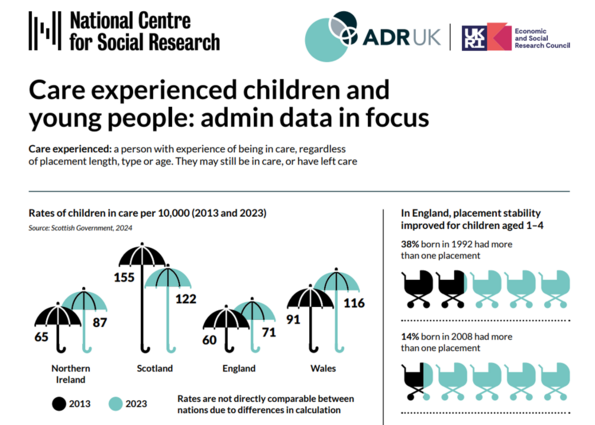
In parallel, ADR UK partnered with the National Centre for Social Research (NatCen) to publish a landmark report on care experiences across the UK. Using administrative data, the report uncovered significant disparities in how children and young people enter and experience care, as well as the long-term outcomes they face.
ADR Wales is working with Torfaen County Borough Council to help them better understand their data and the insights possible through data linkage. The collaboration led to the creation of the Torfaen Health Determinants Research Collaboration (HDRC), a business plan integrating research into council operations, and a successful funding bid to the National Institute of Health and Care Research. The HDRC will support the sharing of local authority data for approved linkage projects within the SAIL Databank to improve understanding of the wider determinants of health, thereby enabling partners to address health inequalities more effectively.
Other innovative ADR Wales partnerships include work with Social Care Wales. Through extensive engagement with the social care workforce and stakeholders, ADR Wales has helped map sector priorities and show how administrative data linkage can support evidence-based decision-making.
This collaboration also identified key areas where social care data can address critical knowledge gaps. The ADR Wales Housing and Homelessness team has worked closely with the sector — particularly youth homelessness services — to support the use of data in driving meaningful change. The Magenta project stands out for its co-production model, engaging directly with those affected by the research.
Showcasing the potential of administrative data research
ADR UK research aims to make an impact and improve lives, and teams across the partnership have been communicating our work in diverse ways to increase its potential impact.
Innovative events have provided opportunities to increase the reach of our work. ADR Scotland held a successful workshop on work, welfare and economy research, which explored the Registration and Population Interactions Dataset (RAPID) and Scottish Longitudinal Education Outcomes (LEO) datasets, and their potential to answer important policy questions around poverty, welfare and educational outcomes.
All ADR UK national partners took part in the Pint of Science 2025 festival, hosting science engagement events in pubs across the four nations, to foster public dialogue and build awareness around how research impacts society. And the ADR UK Researcher Symposiums continue to bring the wider researcher community closer to the insightful work taking place across our partnership. Two symposiums this year focused on education and care experienced children and young people, with another symposium on climate and sustainability coming up soon.
The Office for National Statistics (ONS) has continued to track the impact of research using ADR England flagship datasets. Highlights include research using the LEO dataset to examine long-term outcomes for pupils suspended during secondary school. The findings received widespread media attention, with education unions echoing calls for early intervention and greater access to support services. The Department for Education further acknowledged the need to address broader behavioural factors, such as mental health and family support.
For ADR Northern Ireland, the Northern Ireland Statistics and Research Agency (NISRA) has further developed its communication of research findings through engaging and concise new policy briefs, ensuring insights are more accessible to a wider audience for greater impact.
Meanwhile, research using the Annual Survey of Hours and Earnings linked to 2011 Census - England and Wales dataset found significant differences in workplace pension participation between ethnic groups, with implications for future retirement incomes. The team presented their recommendations to policymakers, industry representatives, and other stakeholders interested in retirement outcomes.
